case study
2025-2026
Design System

Canadian Tire
Role: Team Lead • Designer • Workshop Facilitator • Design Ops
Figma • Figma Sites • ZeroHeight • Lucid • Jira
The Challenge
In 2024, I was brought in by Canadian Tire to revitalize their design system ecosystem. The organization faced a significant hurdle: their existing component libraries were fragmented, outdated, and neglected, making it nearly impossible to maintain brand consistency across their diverse portfolio of websites and platforms.
Leading a team of two, I conducted a deep-dive audit of the existing libraries and documentation to identify gaps and create a strategic roadmap.
The Strategy:
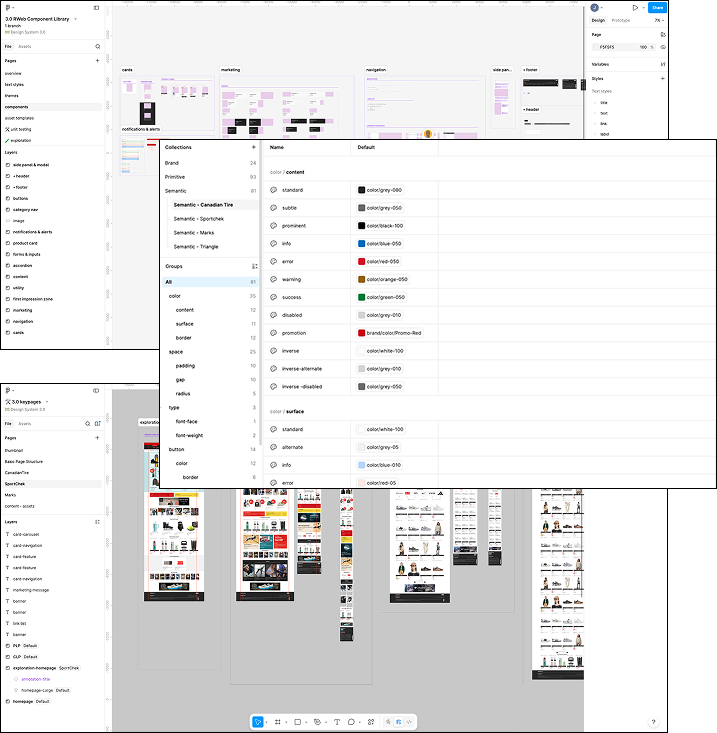
My assessment revealed that a simple update wouldn't suffice. I recommended building a completely new, centralized, scalable design system designed for scale. The goal was to create a themeable architecture that could seamlessly support multiple brands (such as Canadian Tire, Sport Chek, Marks and Party City) across various frameworks and platforms.
Governance & Collaboration:
To ensure cross-functional buy-in and alignment with business requirements, I established a Design System Working Group. team included:
- Core design system team (2 designers)
- Managers from UI Design, UX Design, and UX Strategy
- Front-end Development Lead
- Design Ops
Our mandate was to define, govern, and advocate for the development and long-term growth of the new system.
Execution & Proof of Concept:
We kicked off the project by selecting a modern tech stack and defining a phased roadmap.
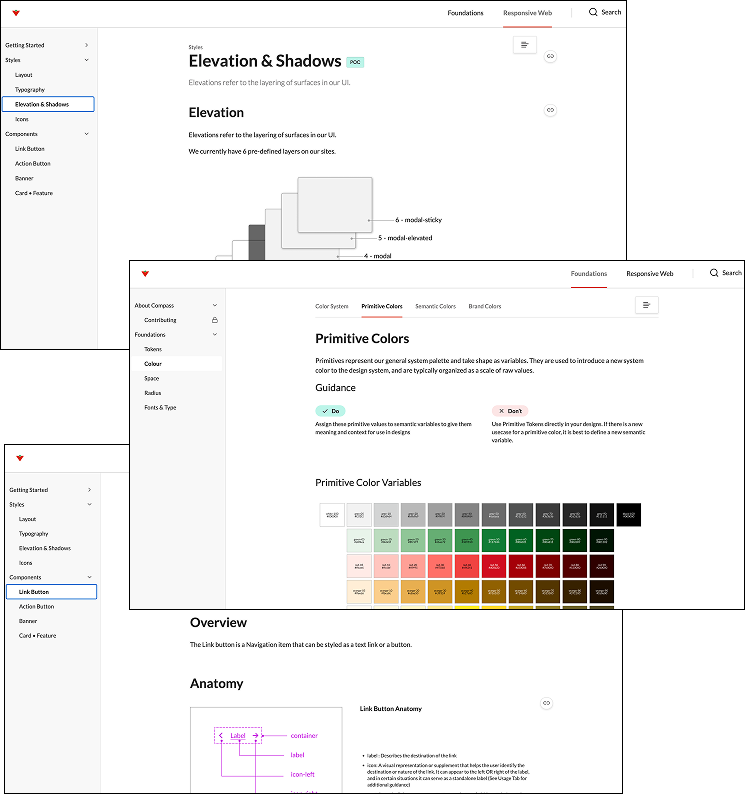
- Foundations: We established a robust architecture using design tokens, customized themes, and standardized layout grids and breakpoints.
- Consolidation: We audited legacy libraries to consolidate redundant components, minimize technical & design debt, and identify "missing" elements required for the new system.
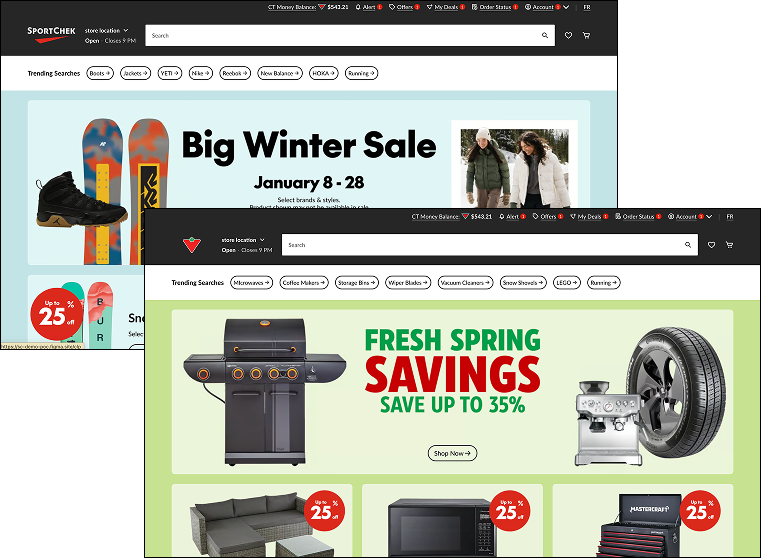
- The Proof of Concept (PoC): To secure executive funding and resources, we needed to demonstrate immediate value. We used Figma and zeroheight to build high-fidelity PoC demos for Canadian Tire and SportChek.
case study
2025-2026
Design System
Canadian Tire
Role: Team Lead • Designer • Workshop Facilitator • Design Ops
Figma • Figma Sites • ZeroHeight • Lucid • Jira
The Challenge
In 2024, I was brought in by Canadian Tire to revitalize their design system ecosystem. The organization faced a significant hurdle: their existing component libraries were fragmented, outdated, and neglected, making it nearly impossible to maintain brand consistency across their diverse portfolio of websites and platforms.
Leading a team of two, I conducted a deep-dive audit of the existing libraries and documentation to identify gaps and create strategic roadmap.
The Strategy:
My assessment revealed that a simple update wouldn't suffice. I recommended building a completely new, centralized, scalable design system designed for scale. The goal was to create a themeable architecture that could seamlessly support multiple brands (such as Canadian Tire, Sport Chek, Marks and Party City) across various frameworks and platforms.
Governance & Collaboration:
To ensure cross-functional buy-in and alignment with business requirements, I established a Design System Working Group. team included:
- Core design system team (2 designers)
- Managers from UI Design, UX Design, and UX Strategy
- Front-end Development Lead
- Design Ops
Our mandate was to define, govern, and advocate for the development and long-term growth of the new system.
Execution & Proof of Concept:
We kicked off the project by selecting a modern tech stack and defining a phased roadmap.
- Foundations: We established a robust architecture using design tokens, customized themes, and standardized layout grids and breakpoints.
- Consolidation: We audited legacy libraries to consolidate redundant components, minimize technical & design debt, and identify "missing" elements required for the new system.
- The Proof of Concept (PoC): To secure executive funding and resources, we needed to demonstrate immediate value. We used Figma and zeroheight to build high-fidelity PoC demos for Canadian Tire and SportChek.
case study
2025-2026
Design System
Canadian Tire
Role: Team Lead • Designer • Workshop Facilitator • Design Ops
Figma • Figma Sites • ZeroHeight • Lucid • Jira
The Challenge:
In 2024, I was brought in by Canadian Tire to revitalize their design system ecosystem. The organization faced a significant hurdle: their existing component libraries were fragmented, outdated, and neglected, making it nearly impossible to maintain brand consistency across their diverse portfolio of websites and platforms.
Leading a team of two, I conducted a deep-dive audit of the existing libraries and documentation to identify gaps and create a strategic roadmap.
The Strategy:
My assessment revealed that a simple update wouldn't suffice. I recommended building a completely new, centralized, scalable design system designed for scale. The goal was to create a themeable architecture that could seamlessly support multiple brands (such as Canadian Tire, Sport Chek, Marks and Party City) across various frameworks and platforms.
Governance & Collaboration:
To ensure cross-functional buy-in and alignment with business requirements, I established a Design System Working Group. team included:
- Core design system team (2 designers)
- Managers from UI Design, UX Design, and UX Strategy
- Front-end Development Lead
- Design Ops
Our mandate was to define, govern, and advocate for the development and long-term growth of the new system.
Execution & Proof of Concept:
We kicked off the project by selecting a modern tech stack and defining a phased roadmap.
- Foundations: We established a robust architecture using design tokens, customized themes, and standardized layout grids and breakpoints.
- Consolidation: We audited legacy libraries to consolidate redundant components, minimize technical & design debt, and identify "missing" elements required for the new system.
- The Proof of Concept (PoC): To secure executive funding and resources, we needed to demonstrate immediate value. We used Figma and zeroheight to build high-fidelity PoC demos for Canadian Tire and SportChek.